Friday, September 28, 2012

Lakefront Brewery Fixed Gear All-Grain Kit from Northern Brewer

Brew date 9/28/2012

Using this recipe.To produce a clone of Lakefront Brewery's Fixed Gear American Red.
Here is the Beer Recipator breakdown of this brew.
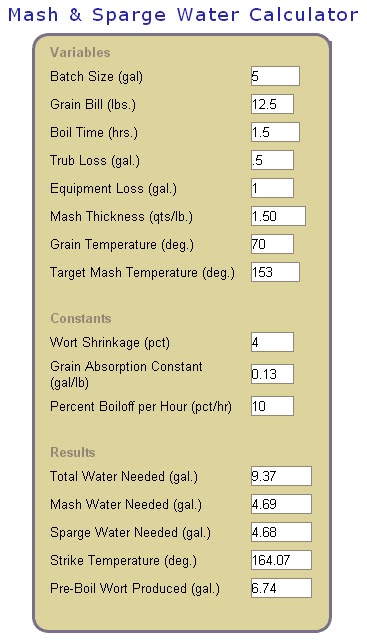

Mashed in with 165 on the thermometer. Mash temp after mash-in (at 11:51 a.m. CDT) was 154. Exactly 1 degree F above the target of 153. Since Brew365's Nifty Mash Temp Calculator recommended 164 as the strike temp. It was pretty much dead on. I'm not going to worry about the 1 degree difference.

Here is how the temps for the mash worked out:
11:50 a.m. (pre-mash): 165F
11:51 a.m. (after mash-in): 154F
12:24 p.m.: 152F
12:32 p.m.: 151F
12:41 p.m.: 150F
12:51 p.m.: 149F


Mash
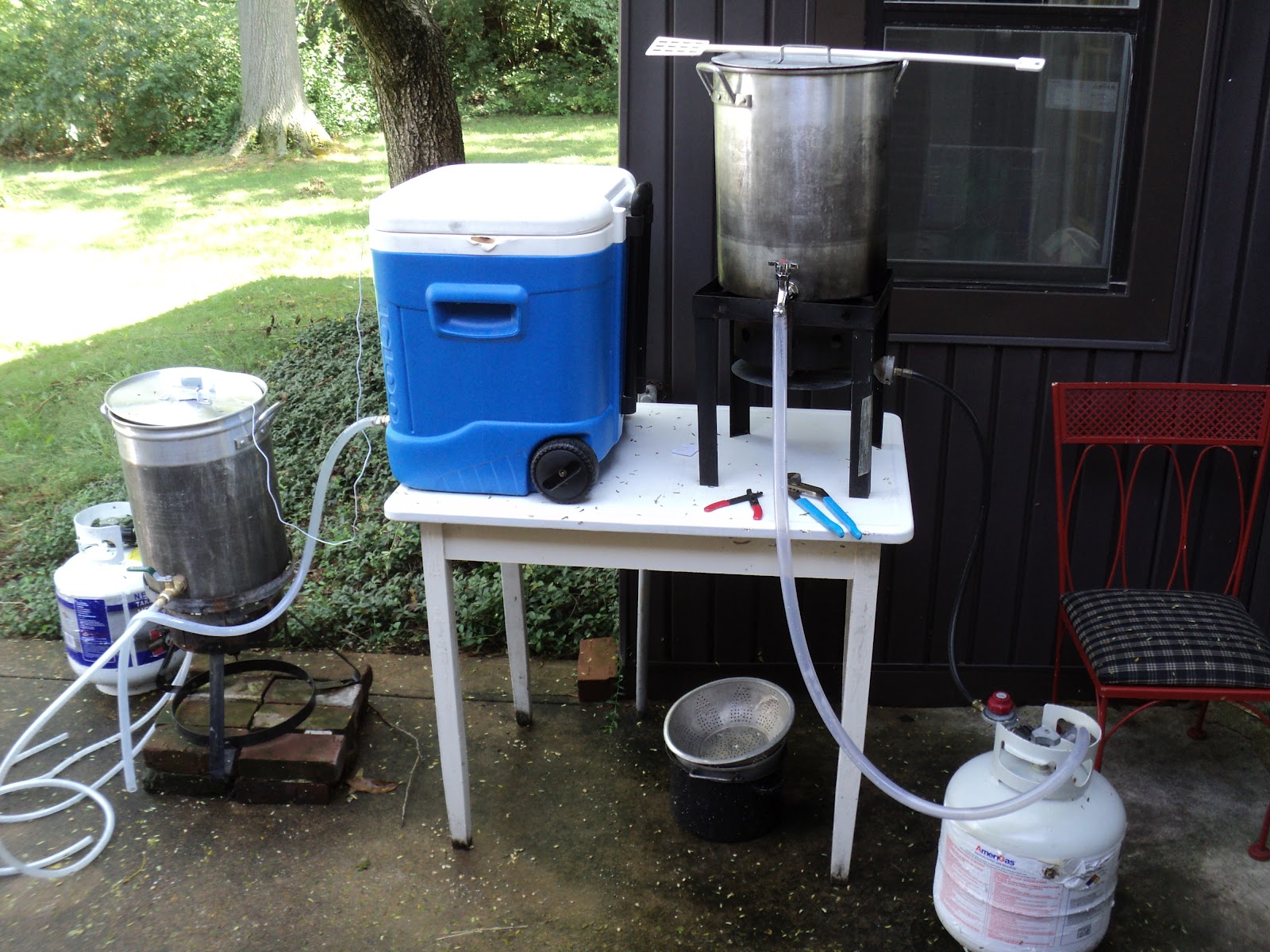
I took the strike water all the way up to boiling before transferring it (with gravity power via nylon hose) to the mash tun.

The initial temp after transfer was 180ish. So I had to wait for it to lose 15 degrees before mashing in. This scenario is by far preferable to transferring at a low temp then trying to heat it back up by drawing off, boiling, and re-introducing 1 gallon of hot liquor at a time which can literally take hours. Trust me.

If I feel daring next time I'll only bring the strike water up to 200F before transferring to save a little time.
The mash rendered 2.75 or so gallons of 1.080 SG wort. The color is a BEAUTIFUL deep red. Since Lakefront recommends a 90 minute boil, I began boiling the first runnings right away. I didn't begin transferring the batch sparge runoff into the boil kettle until over half an hour later anyway.

At the end of the mash I ran the iodine test. I've never done this before and don't think I will again. I had the iodophor sitting around and thought it would feel good to be sure conversion was complete after an hour. Sure enough, it was. The plate on the left is iodophor + first runnings. The plate on the right is iodophor + water as a control.

Sparge
By the time the first runnings were in the boil kettle, the sparge water I had pre-heated had dropped all the way to 150F. I wanted to sparge at a more typical mash-out temperature (170F-ish) so I fired up the burner under the sparge water and waited. When the sparge water (4.75 gallons of it to be exact) had reached 200F+--just this side of boiling--the temperature of the grain (12.5 lbs. plus residual liquid) was around 130F.

Not taking the time to do all the calculations I just brought all 4.75 gallons of sparge water over into the mash tun. When transfer was complete the temperature of the grain-water mixture in the tun was 168--pretty much perfect. I worried a little about small-scale tannin extraction at the spot where the liquid was entering the tun @ 200+ degrees. I would welcome comments about whether this is something worth worrying about or not. If so, the only solution I can think of is a traditional fly-sparging style sparge arm to trickle in the liquid from above. Thoughts? Anyone?

Second runnings SG = 1.030.

Boil
The official 60-minute boil began @ 2:51 p.m. with a .5 oz addition of Columbus hops. The S.G. was 1.052 or so. The first and second runnings had been combined in the kettle and had been boiling for easily over half an hour. I let the last half-gallon of sparge runnings slowly drain from the mash tun during this time. Once this liquid was added to the kettle and the full volume had regained it's boil, I followed the schedule shown below exactly.


BOIL ADDITIONS & TIMES
.5 oz. Columbus (60 min)
.5 oz. Chinook (20 min)
1 oz. Cascade (5 min)

Chill & Transfer
O.G. = 1.060

Aerate & Pitch Yeast
Used my patent-pending (meaning I may or may not apply for a patent at some point in the future) method of aeration.

Begin by allowing wort to settle in a sanitized carboy. Once wort is within 10 degrees Fahrenheit of the yeast that you intend to pitch use a sanitized autosiphon to siphon the wort into a sanitized one gallon container 1/2 gallon at a time. Take each 1/2 gallon of wort and shake vigorously before pouring into a 2nd sanitized carboy. About halfway through this process is a good time to pitch your yeast starter. Terminate the process just before the trub at the bottom of the first carboy starts to sneak into the siphon hose. A few ounces of trub is acceptable.

Ferment
Unfortunately I was only able to make 1.2L of 1.025 SG starter wort. I would have preferred to make 2L of 1.035 starter wort. This being an imperfect world and all, I'll look on the bright side and note that a small amount of weak starter wort is better than no starter wort at all.

On the right side of the photo above is my ferm fridge and Johnson Controls model A419 thermostat. This will allow me to ferment the beer at exactly 65F. At the start of the aeration process the measured temperature of the wort was 74F. As soon as aeration and pitching were complete the carboy of inoculated wort was placed in this ferm fridge and the temp set to 65F. I will check the temp again in the morning.

Dry Hop
1 oz. Citra (dry hop 7 days)
1 oz. Chinook (dry hop 7 days)

Friday, February 24, 2012

Global Climate Change Kolsch

Brewed in honor of the 68°F sunny day we had in St. Louis, Missouri on February 23, 2012, this is the simplest Kolsch recipe I've ever made. A very helpful person at St. Louis Wine and Beer Making found the recipe in a book and sold me all the ingredients pre-measured. No weighing grains this time. I haven't made a Kolsch sans flavor/aroma hops before. Likewise this is my first Kolsch not to feature at least a pound of wheat malt. I suspect this is because the wheat malt is to aid in head retention -- a role obviated by the character of Pilsner malt.

Now for the problem. (There always has to be one. Doesn't there?)

I usually violenty shake the fermenter at 1 to 1.5 gallon intervals during transfer. The properties of the Pilsner malt (which I had never used before) caused the carboy to fill with foam and overflow. Oops. Any ideas on how to aerate wort when Pilsner was the base grain?

Anyway, the aeration seems to have worked. There is a 3-inch kraeusen on the beer less than 12 hours after pitching. Other factors that may have contributed: the production date on the packet of Wyeast 2565 was a mere 48 hours prior to brew day, making this the freshest (ergo healthiest and most populous, theoretically) yeast I've ever pitched. Also my digital thermometer went on the fritz during chilling, which means I only have a rough guess as to the temperature of the wort when the yeast was pitched. It's not impossible that the wort was so warm that the yeast went instantly into overdrive. We will find out at racking time by tasting if the hydrometer sample has molto bananas or other fruity esters.

Clean Out the Fridge IPA

As the name implies, this IPA recipe was formulated using only the grains, hops, and yeast I had on hand. The brewing bug grabbed me at around 11a.m., and there was no time to make a run to my LHBS for ingredients. Hence she's not exactly a traditonal IPA hop-wise. The hop schedule was inspired quite loosely by recipes for Surly Furious clones I've seen around the web.

Beer Recipator: Clean Out the Fridge IPA

Tuesday, January 31, 2012

Krekow Kommon

Basically, we're making Northern Brewer's California Common.
Here's the Beer Recipator recipe: Krekow Kommon.

Every brew day is an adventure. For the first time since I started brewing all-grain today I overshot my mash temp by at least 4F. Target mash temp: 152F. Actual temp: 156F. My solution: I added what I guess was less than 1/2 gallon of cold water directly from the hose into the mash. Once I stirred it up and sealed the lid of my mash tun, the thermometer fell to 151 and held there for the next 57 minutes until I began the vorlauf process. I wonder what the net effect of those 3 hot minutes at the beginning of the mash will be. I think I'll go ask them over at homebrewtalk.com.

***Update***
Little did I know when I typed the words "Every brew day is an adventure" what kind of adventure, or nightmare really, was still in store for this Brew Day. I can't bring myself to describe the horror right now, so the gory details will have to wait for a future post -- with pics and video.

Saturday, January 7, 2012

Fullerish A.K.A. Fulleresque Redux

I liked the Fulleresque so much, I wanted more, ASAP. Luckily, I had left overs of most of the ingredients. I was completely out of flaked maize, so that will be a major difference. Also Fullerish is going to be a bigger brew what with 12lbs. of base grain rather than 9.

Beer Recipator: Fullerish A.K.A. Fulleresque Redux


***Update***
At first this tasted too sweet. Not as good as Fulleresque. That was a couple of weeks ago. Now it's pretty darn good -- only a slight hint of that original sweetness. I have saved a couple of bottles of Fulleresque, and a growler of Fullerish in the fridge for a head-to-head taste test this weekend. (Feb 25, 2012)

And the winner is . . .

Saturday, December 17, 2011

Fulleresque ESB

Notes to self for future brews with grain bills in the 10-11 lbs. range:
  • 3.5 gallons of strike water @ 175 F will hit 168 F upon being transferred to mash tun.
  • 10.5 lbs of room temperature grain will bring the mash to 152 F exactly.
  • After an hour the mash had lost 4 degrees reaching 148 F. (While this is acceptable, in the future we will preheat the mash tun with even hotter liquor (perhaps 185) and let the temperature settle a while before doughing in.)
  • This will yield approximately 2 gallons of wort @ 1.067-1.070 specific gravity.
  • After vorlauf and draining off the first runnings, 4.5 gallons of sparge water @ 185 F will bring 10.5 lbs of saturated grain to 166-168 F.
  • This will yield 4.5 gallons of 1.027-1.030 SG wort. Mixed with the first runnings, this will give 6.5 gallons of 1.040-1.044 SG wort.

Perfect!
Beer Recipator: Fulleresque ESB

Update: On 1/7/2012 while preparing my FullerISH (not -ESQUE) ESB , I needed a grain absorption constant so as to know how much sparge water would be needed a 6.5 gallon boil. Luckily I was able to use the above figures like so: 10.5 lbs of grain absorbs 1.5 gallons of water. 1.5/10.5 = .143 which is my grain absorption contant in gallons per pound of grain. Since the Fullerish has a 13 lbs. grain bill, this means that the grains will absorb .143 * 13 = 1.86 gallons of water. Since I used 4 gallons of 165 degree water in the Fullerish mash, this should yield 4 - 1.8 = 2.2 gallons of runoff. I'm going outside right now to heat up 4.3 gallons of sparge water. Since 4.3 + 2.2 = 6.5 gallons! Ain't 'rithmatic nifty?

Tuesday, October 11, 2011

Eau de Cologne

Beer Recipator: Eau de Cologne

Had my first brew day of the Fall 2011 season on Saturday, Oct. 8, 2011.

Bright spot of the day: after all that boiling I eventually hit my target O.G. of 1.049 on the nose. Huzzah!

I'll add tasting notes and other comments to this post once I transfer to secondary. Since you can't comment directly on the Recipator page, please do so below.

***Update***
It has been a while so I can't remember specifically how this one tasted, other than to say I was pleased with it and it disappeared quickly. To this recipe's credit, renowned St. Louis area thespian Richard Lewis gave it high praise and asked for another.